The best AI risks come from the bridges, not the individual AI brainstormers
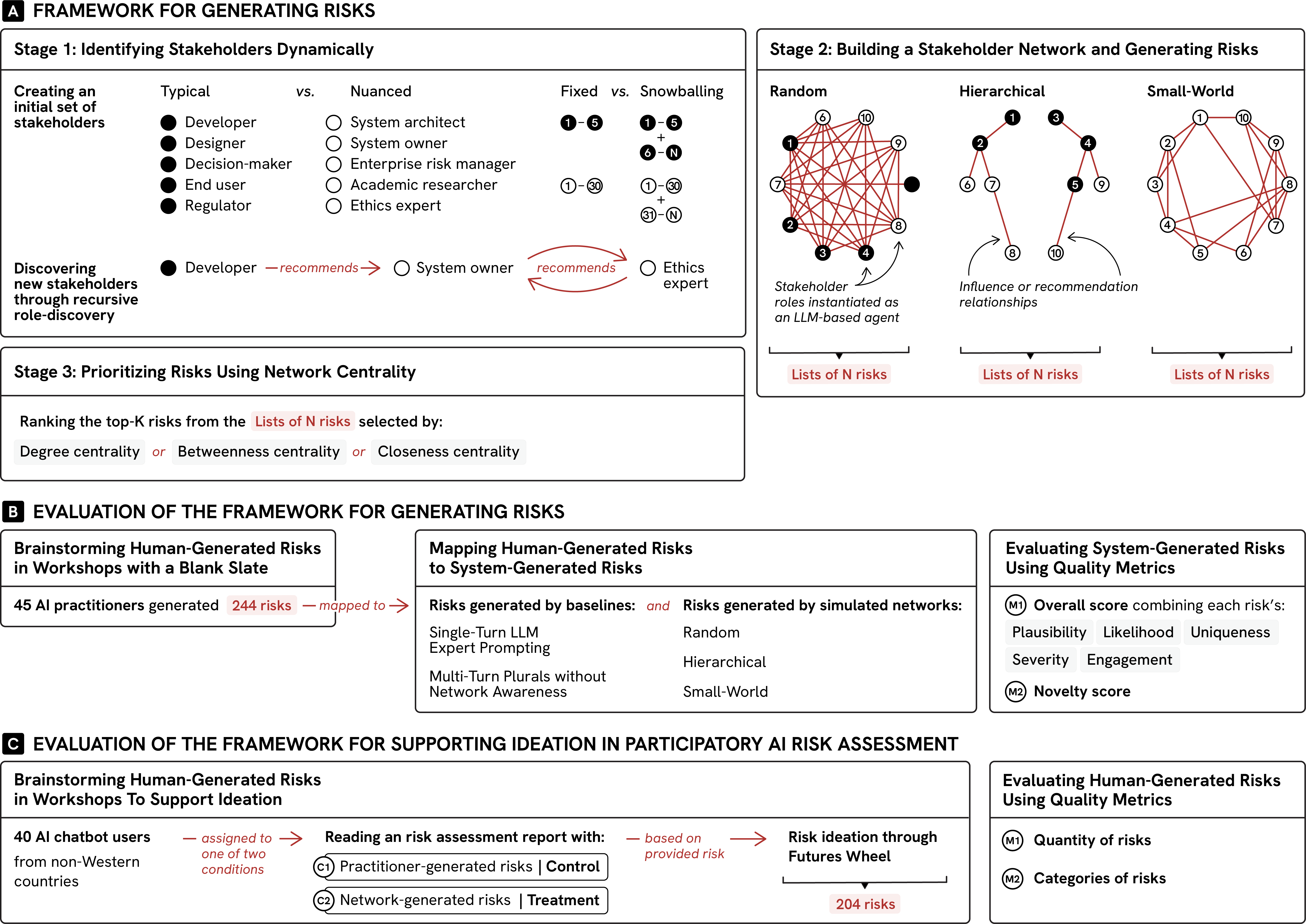
This study had AI agents role-play every stakeholder in a companion chatbot: developers, designers, regulators, a clinical pharmacist, even a parent. The most dangerous risk in the entire study didn't come from the developer. It came from the parent.
Here's the setup. This study built a tool that maps every stakeholder an AI system touches, turns each role into its own AI agent, connects them in a network, and lets them argue about what could go wrong. Then they ranked the risks, not by how scary they sounded, but by who raised them.
The agents playing developer, product manager, and IT manager produced exactly what you'd expect: incompatibility with existing infrastructure, servers crashing under load, standard data-privacy issues. Valid. Also things every engineering team already knows.
The agent playing a parent surfaced something none of the technical roles did: kids forming an unhealthy dependence on the chatbot that quietly erodes their real-life relationships. Highest novelty score in the study, and it lifted the tool's overall novelty over standard expert brainstorming by roughly a full point on a 5-point scale, without making the risks any less plausible or severe.
Here's the uncomfortable part: novelty isn't random. Even among AI agents, it's structurally concentrated in the roles that sit between worlds: a parent bridging home and technology, a clinician bridging medicine and AI. The obvious technical roles reinforce what the room already knows. The bridge roles see what no one else can.
Which means the most valuable perspective in your next AI risk review probably belongs to a role that isn't in the room. And the blank whiteboard you start from guarantees your team burns its energy re-listing "privacy" and "bias" long before it reaches the risks that actually blindside you. So don't start from blank. Map your bridge stakeholders first, and then bring the hard risks into the room.
Publications
- Small-world Networks of Agents Brainstorm AI Risks to Support Ideation. AIES 2026 PDF